Showing posts with label gunzel. Show all posts

Thursday, January 27, 2011

Melbourne's Newest Station


It is of course Coolaroo on the Craigieburn line. For me this station has always been an enigma as it had always been marked as a future station in the Melway street directory. When the rail line between Broadmeadows and Craigieburn was electrified back in 2007 it was however ignored in favour of a station at Roxburgh Park instead (itself built on the site of the closed Somerton Station) Due to public demand the government finally built Coolaroo Station and it opened for business in June 2010. I stopped by on a sunny Sunday afternoon all the way back in August to take a look.


It surprised me that the landscaping was nice but simple. Also amazing was the fact that none of the plants had been pulled out! (also note the clearly marked and very well situated disable parking)


Nice big shiny letters and seats to sit on while waiting to get picked up. I would think the seat would be unusable on a hot summer afternoon as it faces due west. The metal would be scorching and the heat radiating off that wall unthinkable. I hope they keep the water up to that tree, it will be needed in the future. There are a number of these trees in this area out the front, they appear to be a native Sheoak/Casuarina, so should handle the conditions well.


This is one of the stairways. Disabled people are catered for by an elevator (you can just see the top of the door). Also a track for pushing bicycles up/down the stairs is provided


This is the city bound platform. It's pretty barren, but at least there are quite a few seats and some shady areas to wait under.


The passenger information display or PID on the city bound platform.


The Craigieburn platform. Pretty much the same deal as the other.


Station sign, and example of the building materials used. Very basic, some would say cheap.


Looking towards Craigieburn (Roxburgh Park is the next station though), and ultimately Sydney, Although with a change of gauge in Brisbane you could go on Mount Isa, Cairns, Kuranda and Forsayth. The interstate standard gauge is the track on the right.


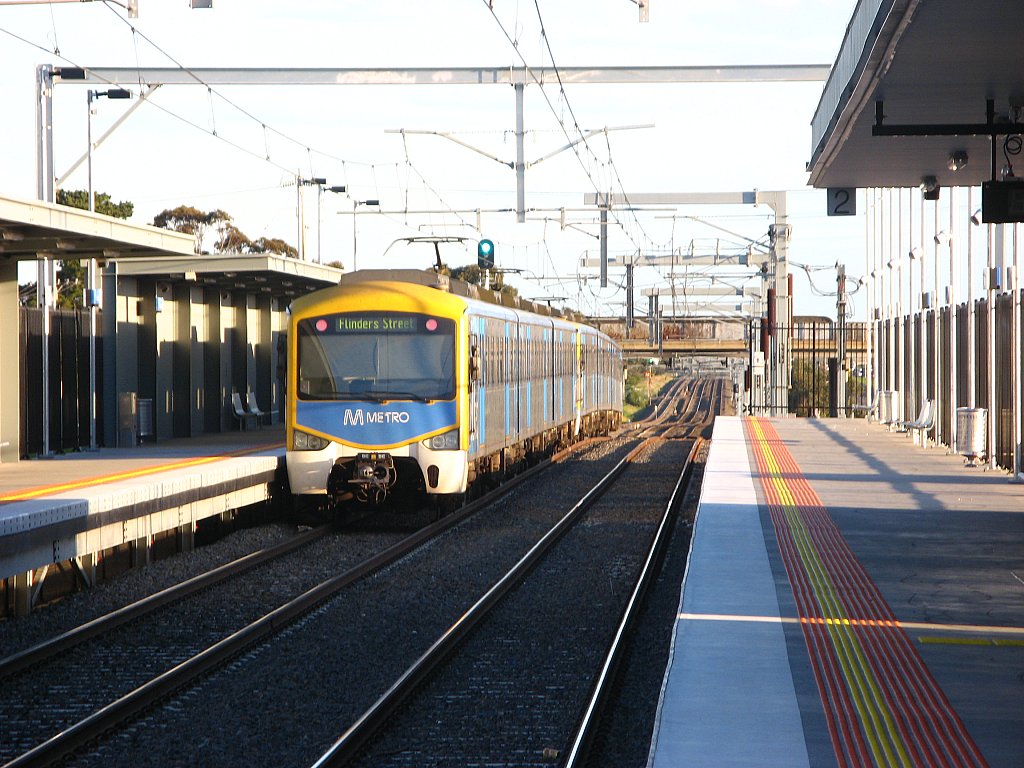
A Siemens train approaches, bound for Flinders Street.


On each platform are some basic necessities for travel, including both Metcard and Myki vending machines and validators. There are also the usual posters showing maps, timetables and fare information.


A better view of the approach to platform 2 and the main station "building". The words plain and boxy come to mind.


The only design flourishes seem to be the red colouring on the stairs and a collection of words on the side of the overpass. And more Sheoak trees.


A close up of the interesting collection of "feel good" wording on the side of the overpass.


Interesting to see a water tank as well. It will be needed to keep those trees alive.


There is also a very large car park.


Just as I was leaving this V/Line sprinter bound for Seymour passed through.

A few notes:

Not pictured is a dedicated kiss and drop are which is a good touch, there are a number of short term (5 min parking spaces and an area to turn around in.

In terms of pedestrian access residents of the residential area on the western side have to cross the four lane Pascoe Vale Rd at a set of traffic lights. Pedestrians from the residential area on the eastern side have direct access via the station overpass. The 901 smartbus also serves this station from a pair of stops on Pascoe Vale Rd. As such people changing between the Frankston bound bus and train or vice versa also need to cross at the traffic lights.


Overall Impresions

My impressions are that the station is quite windswept and desolate. On the outside it just feels like a concrete oven. Although they have tried to counter this with some plantings. This really is a case of function over form, so you can't really complain.

That's one ghost station down. In all there are four new stations expected to be built on the existing Melbourne rail network over the next few years. Of those Lynbrook is one which has also been marked in the Melway Street Directory for many years and so also has that ghost station appeal about it. Lynbrook is to be completed some time this year...

Monday, February 23, 2009

QLD Day 3 - Ipswich Workshops

Citytrain set 262, These trains almost identical to Perth's
new trains. They were built by the same factory, EDI
Walker in Maryborough QLD

One of the Electric Tilt Train sets before departure to
Rockhampton at Roma Street station.

Today I ventured all the way out to Ipswich to go to the Workshops Railway Museum. It was about and hour train ride from the city and it was interesting to see the landscape change from lush to more scrubby type vegetation on the way. I thought Ipswich was an outer suburb of Brisbane, but it is really it's own city, as there is actually quite a gap between the two. From Ipswich station it was a short 5 minute bus ride to the museum, and the bus connected with the train perfectly (harmonised headways). Overall I spent about 4 hours at the workshops, partly due to the Bus Schedule and partly due to the timing of the various tours you can take.

Loco 1262, to the left can by seen loco 1710 which
now contains a train driving simulator

Inside the cab of 1710

The museum itself is rather small with a few examples of locomotives and rolling stock, plus many interactive displays including a train cab simulator.

Lego Coal train

Model coal train

Queensland loco 1281 in it's golden splendour

Diesel shunter DL1

Loco no.6

The Ipswich workshops are still active and is where the Queensland Rail heritage fleet is maintained and stored. In the sheds there are many steam locomotives and items of rolling stock in various states of repair.

A locomotive under repair at the workshops

Garratt 1009

Beyer-Garratt builders plate on 1009

The workshops are also home to a blacksmith's workshops which makes all kinds of objects for both the heritage arm of the railways, the day to day needs of QR as well as outside contracts. What seems amazing to a Victorian is that all of this is state funded, is based on full time employees, and some parts such as the blacksmith workshop make a profit.

Sparks fly in the blacksmith's workshop.

On both the workshops and blacksmiths tours we got to ride on the traverser which is used for moving rolling stock around the workshops.

The traverser

Due to timing and bus schedules I didn't leave the workshops until will after 3 pm. As such the bus was packed with school kids, I managed to find a seat at the back, but some of the kids at the front wouldn't stand for an old lady, and they were giving the bus driver a hard time by always pressing the stop request button whether or not anyone wanted to get off. Coincidentally a few days I heard a news story about a bus driver in Ipswich who ended up driving to the police station after a school kid threw something at his head while driving. I thought of my bus ride.

Once again it was a smooth train ride back into Brisbane.

That evening I went to the cinema near my hostel to see Gran Torino. When I was in the ticket line still wearing the grotty clothes I'd been in all day I realised everyone else was rather well dressed. Feeling a bit embarrassed I decided to dash back have a shower and get changed before the movie. Not having time for dinner I thought I'd get by on some popcorn and a drink, but somehow I ended up with the combo that also included a choc-top. The weird thing was that it was cheaper than just the drink and popcorn.


As it turns out, after the movie I was a bit peckish, and so went to a nearby take away and had the worst kebab of my life. It was really dry and didn't taste very good at all. The night still being relatively early I ended up going for a walk down to the XXXX brewery and back again, which was just down the road.

XXXX Milton Brewery - the view across the road
from my hostel.

Saturday, November 29, 2008

New modus opperandi: City Loop

As most people will be aware by now 2 or 3 weeks ago changes were made to the way the Epping/Hurstbridge and Werribee lines use the city loop. In peak times the Werribee line has been removed completely running direct to and from Flinders Street via Spencer Street. At non peak times and on weekends and public holidays it operates as normal.

The Epping and Hurstbridge lines have been altered to run in a clockwise direction during the week, direct to Flinders Street before going around the full loop, and anti clockwise around the loop direct to Parliament on weekends.

I for one am in favour as it makes my life for about half the week much easier. I no longer have to travel to Parliament, change to a Northern loop train to get to Flinders Street and then get my Belgrave/Lilydale train from there. The alternative was to travel the whole way around the loop which could take nearly 20 minutes if you got halted a few times on the viaduct between Southern Cross and Flinders Street. Often changing at Parliament was the difference between catching a train and not...

Now I go direct, sure there is sometimes a bit of a crawl between Jolimont and Flinders Street, but that is to be expected when there are only 2 platforms that my train can use, plus conflicting moves with trains on the Burnley Group going the other way. Actually that last part is probably the most contentious issue, as both the Burnley Group and Clifton Hill groups now vie for one piece of track from opposite directions if platform 14 at Flinders Street is occupied. That part really sucks. In general my connections are much smoother than they used to be.

I don't really like the arrangement on weekends though, as I used to like getting off at Flinders Street on a Saturday morning and walking up through the city to where ever I needed to go. I guess I will learn to live with it. From my understanding it is run this way to keep the outbound track from Flinders Street to Jolimont in working order and to keep train drivers knowledge of this track up to date. On the first weekend of this operation I recall the confused expressions of other people on the train as it went into the city loop.

It all seems to have bedded down rather well now, although I understand the Werribee line pax are still having issues with transfers to loop trains at North Melbourne and Southern Cross.

Wednesday, July 16, 2008

Out and about

Last week I had a day off work and while I was out and about doing un-work like things I happened to see Bumblebee 1. Bumblebee 1 is one of the 5 tram's that Yarra Trams has borrowed from it's sister company in Mulhouse, France. These 5 trams are Citadis trams like those already used in Melbourne, the main difference being that they are longer (5 segments as opposed to 3), have styling differences, and not to mention they are very VERY yellow. I think they look great, that yellow really stands out from the grey of Melbourne in winter, and the other grey trams. Two thumbs down to Yarra Trams for painting all the trams grey and white, one thumb up for sticking with the yellow on the borrowed trams.


Bumblebee 1 turning into Bourke Street from Spencer Street

After I had finished my business in town I had a few hours to kill so I decided to go for a train ride somewhere. That somewhere turned out to be Sunbury, so I boarded the 1515 service to Echuca. What impressed me was the utilisation of the rolling stock. It was a six car V/locity with three 2 car trains. At Sunbury the 2 rear carriages were dropped off, and a further 2 were to be dropped off at Bendigo, with the remaining 2 cars continuing on to Echuca. At each of the intermediate stations the cars that were dropped off were to form return services to Melbourne. Passengers were advised of which cars to travel in to reach their destination in numerous announcements throughout the journey. To me this seems like a brilliant use of rolling stock.

VLocities at Sunbury.

When I alighted at Sunbury I noticed that there were a large number of people standing in the aisles of the first 4 cars. There was another VLocitity waiting in the siding at the end of the platform that I gather was dropped off the previous Bendigo train. After waiting for a few minutes the Bendigo and Echuca portions continued on, and the two remaining sets coupled to form the return to Melbourne. Soon enough I was on my way in a very sparsely occupied 4 car set. In all there were probably about 5 people in the 2 car set I was in. On arrival back at Southern Cross this train formed a Traralgon service and there were many passengers waiting.

I guess my point is that I like the idea of using and dividing/joining multiple units to make the best use of rolling stock. While the return to Melbourne was void of passengers it was immediately used for a service to somewhere else where there was demand. Two thumbs up to V/Line.

Sunday, April 20, 2008

Rail to Doncaster

In The Age today is an opinion piece written by Graeme Davison. He rightly asserts that the Doncaster rail line should have been built 40 years ago when the area began to be heavily developed, but is against the building of a line because of the issues involved with tunnelling and the fact it would travel along the Eastern Freeway away from where the potential passengers live:

Yet, for more than half its length, a Doncaster railway would run through the Yarra Bend National Park and across the parkland and golf courses of the Yarra River flats. Golfers and bushwalkers might welcome it, but it would generate next to no commuter traffic. At North Balwyn (Burke Road), passengers would alight about half a kilometre from the nearest houses, while on the north side of Bulleen station, students from Marcellin College are about the only prospective customers. The line would cross Doncaster Road about 1.5 kilometres from the main transport and shopping hub, Shoppingtown. You would either have to tunnel several kilometres under Shoppingtown to East Doncaster, extend the Doncaster tramway to Shoppingtown or rely on feeder buses to reach a station on Doncaster Road.

Davison claims that the railway would travel mostly through parkland and would not create patronage. He seems to conveniently forget that the freeway runs through there too, and does not gain much in the way of traffic from those areas either.

Davison also asserts that you would need to tunnel for kilometres under Doncaster Shoppingtown to East Doncaster. I don't know where he has been for the last 40 years, but a vast amount of tunnelling has always been on the agenda in the Doncaster area. This is not a new thing, and in fact it will help bring the line closer to where the people are, something he uses against the building of the line in the same paragraph.

Davison goes on to claim that:

Transport research shows the reluctance of commuters to put up with bad connections. Any break in transport mode — say, from bus to train — creates frustration, especially if the scheduled service doesn't come. If the Doncaster rail requires a network of feeder buses, the passengers might as well stay aboard the existing express bus services and ride down the freeway along a dedicated lane all the way to the city. Maybe that's why the Eddington report hasn't opted for a Doncaster railway but for a major upgrade of the existing DART (Doncaster Area Rapid Transit) bus service. You may be asking: but don't buses run on polluting and fast-depleting oil? Yes, but although trains run on clean and abundant electricity, that power is generated from the most polluting of all fossil fuels, brown coal. It's only when trains and trams are full that they come out ahead of cars. Railways and trams wear a halo of environmental respectability that is only half-deserved.

To that I say that if the rail frequency and feeder bus frequency are sufficiently high then issues of missed connections will not be a problem. If the rail frequencies on this line were near metro levels (and I would expect the Doncaster line to be part of a segregated network than an extension of the current system) of a train every 5 minutes in peak and every 10 minutes in off peak. Have the feeder buses run every 10 minutes on main roads intersecting the rail line throughout the day, which means the longest connection in the peak would be about 5 minutes and at most 10 minutes off peak. Overall this would equate to an average waiting time for the whole journey of 7.5 minutes peak and 10 minutes off peak. If the connections are good (and by current Melbourne standards these are very good), people will use them.

He does make a good point with the fact that we get our electricity from brown coal. Cleaner and more sustainable energy sources are something that we need to work on. However that does not diminish the fact that all forms of public transport whether powered by electricity generated by burning brown coal, or by burning diesel fuel in a combustion engine, are more efficient at moving large amounts of people than cars are.

This paragraph confuses me though:

The Melbourne 2030 plan was based on the shaky assumption that increasing residential densities around the main public transport system would improve the viability of public transport. But even when density increased, residents often continued to drive their cars. Now there is a swing in the other direction, towards the equally erroneous belief that if you provide the transport, the residential patterns will change and the passengers will come. The Doncaster railway dream is a perfect illustration of that belief.

If anything Davison appears to be having a punt each way in this paragraph. What little development that has occurred under the auspices of Melbourne 2030 has been stymied by contrary government policies and local interests. I would argue that because of this densities have not increased that much in the Melbourne 2030 transit cities. The reason the few new residents continued to drive is exactly as he states, the public transport improvements were not forthcoming, and while they are slowly happening are not happening fast enough. The government is to blame for not having enough will to back up it's own strategies. If anything you only need to look to Perth for examples of where this sort of strategy has been implemented successfully with the Northern Suburbs rail line. In comparison a rail line to Doncaster should be child's play.

In his final paragraph Davison is spot on by stating that public transport needs to be constructed at the time of development, and should have been the case at Doncaster. He is also right that the there needs to be a rail service along Wellington Rd to Monash University and Rowville where there is also a high demand for such services, but there is demand in Doncaster as well.

Monday, March 31, 2008

Regional non-fast rail - Part 2

VLocity unit 15 has completed platform duties,
is closing the doors and is nearly ready to go.

VL 15 heads off around the bend, next station Heathcote Junction.

Track machines in the Standard gauge siding at the Melbourne end of Wallan loop.


This photo was taken at the Hobsons Bay Model Railway Club's Exhibition of Australian Model Railways that is held over the Easter weekend each year. Shown is an N scale model railway layout based on Wallan back when it was a more substantial station (compare now (sort of) and then). In the front are the broad gauge running lines, then the large broad gauge yard, while at the rear is the standard gauge line with two trains crossing in the loop. The track machines in the photo above this one are parked in a small siding that is not depicted, that runs off the start of the loop, and would be parked just behind where the blue and red locomotives are (these are NR class locomotives in Indian Pacific and The Ghan colour schemes BTW). Most crossing loops on the north east standard gauge have at least one such siding for the storage of track machines or broken down locomotives and rolling stock. This layout is owned by the Victorian N Scale Collective.

Sunday, March 30, 2008

Regional non-fast rail - Part 1

Went for a drive today up to Bradford and back home again via Wallan. I decided to stop in at the stations of both these towns and was rewarded at each by a train within 10 minutes of arrival. It was interesting to note that V/Line is using the latest VLocity railcars on this line at weekends despite the fact that this line was not part of the regional fast rail project. During the week it is a mix of older Sprinter railmotors (railcars) and locomotive hauled carriages. Anyway at Broadford I took some photos of this Melbourne bound train, it appeared to have a full seated load which surely is a good sign.

VLocity 1131-1231 approaching Broadford station while on
route from Seymour to Melbourne Southern Cross.

This section of track between Craigieburn and Seymour is notable in that it is the last remaining section of double line block safe working in Victoria (if not in Australia). What this means is that the line is divided into sections or blocks. In total there are 5* blocks, these being:
  • Craigieburn - Donnybrook*
  • Donnybrook - Wallan
  • Wallan - Kilmore East
  • Kilmore East - Broadford
  • Broadford - Seymour
* Until the extension of suburban trains to Craigieburn last year there was a block between Broadmeadows and Somerton and another between Somerton and Donnybrook. When the suburban extension to Craigieburn opened the block instruments from Somerton were moved to Craigieburn.

At each station mentioned above there are machines known as Winter's Block Instruments (Winter being the inventor), one for each section of each line. These allow the signaller to communicate with the signaller at the next or previous station using bell codes and indicator needles to negotiate the progress of a train along the line. The signals are sent along the telegraph wires or other communications lines beside the railway. The system is explained in much better detail at Vicsig.

VLocity 1131-1231 loading/unloading passengers at Broadford.

Anyway the point is that the infrastructure required for Double Line Block can be seen in the photo above. There is the signal box on the right which houses the signaller, signal levers and block instruments. Further down the line you can see the down starting signal in front of the train, which allows a train into the next block. On the right of the other line is the down home signal which accepts trains in to the station. These arrangements are reversed at the other end of the station (somewhat visible in the first photo). These are both lower quadrant semaphore signals. There is also a crossover which at a guess is only used in case of emergency under special instructions from the signaller and train control (Centrol) in Melbourne.

I should also mention Double Line Block allows stations to be "switched in" and "switched out" as needed. So for busy times all the stations can be switched in to allow a maximum number of trains through, while at quieter times some of the stations can be "switched out" . Today was one of those quieter times, and I believe it was operating as a single block from Craigieburn to Seymour.

VLocity 1131-1231 disappearing towards Melbourne.

In this final photo you can clearly see the standard gauge line from Melbourne to Albury to the left of the double track broad gauge line. This line has recently been re-laid with concrete sleepers for it's length and longer passing loops known as passing lanes are under construction. The concrete sleepers allow for higher speeds, particularly on curves, and have a longer life span that wooden sleepers (not to mention that we are running out of good quality red gum that is needed for environmental reasons to remain as trees). The existing passing loops are about 2 km at most, which defines the maximum length of the trains that can run on this line (to I believe about 1.8 km), and require many trains to be "put away" or stopped in the loops in order to cross (rail term for trains passing each other in opposite directions) a train in the opposing direction or be overtaken by a faster train . The new passing lanes in contrast will be many kilometres in length (perhaps 5 to 10 I'm not sure on the specifics) which will allow trains to simply pass each other while moving, which make for even faster travel times. All this work is being undertaken by the ARTC (Australian Rail Track Corporation) a federally funded corporation which manages the interstate standard gauge rail network.

Thursday, November 01, 2007

On the way to work


Only half way there. Taken last week, that's my train approaching at the other end of the platform.

Thursday, October 18, 2007

Bridgewater Bulldog

http://gallery118301.fotopic.net/p44303566.html

Follow the link to view the photo. Former Victorian Railways locomotives S300, T377, T373 hauling a ballast train across the Loddon River at Bridgwater in Northern Victoria. I like this photo. In fact I recommend a look at some of the other photos in this guys gallery.

Sunday, October 07, 2007

Saturday in Melbourne Town

Who says there is nothing to do in Melbourne when the football season is over.

...not that I really care about whether or not it is the football season.

Shoppers crossing Swanston Street at Bourke Street. If I didn't know better I'd swear that horse on the left is whispering something in the other horses ear.

There are those horses again. I think I've interrupted the conversation...

Trams in Flinders Street. I love these new LED destos currently being fitted to the A class trams. Although I think the air conditioning pods ruin the looks of the tram, I'm sure the drivers welcome their presence. I know I hate it when the air-con at my workplace stops working, I'm sure it would not be nice in a stinking hot tram full of sweaty bodies.

Just to illustrate the improvement, here is a B Class tram with the old flip dots. The A class previously had destination rolls, which were OK, but the LED's rock. There are also some Z class trams with LEDs too, perhaps the B's will get them eventually also.